
The Healing Power of Music: What Science and Music Reveal
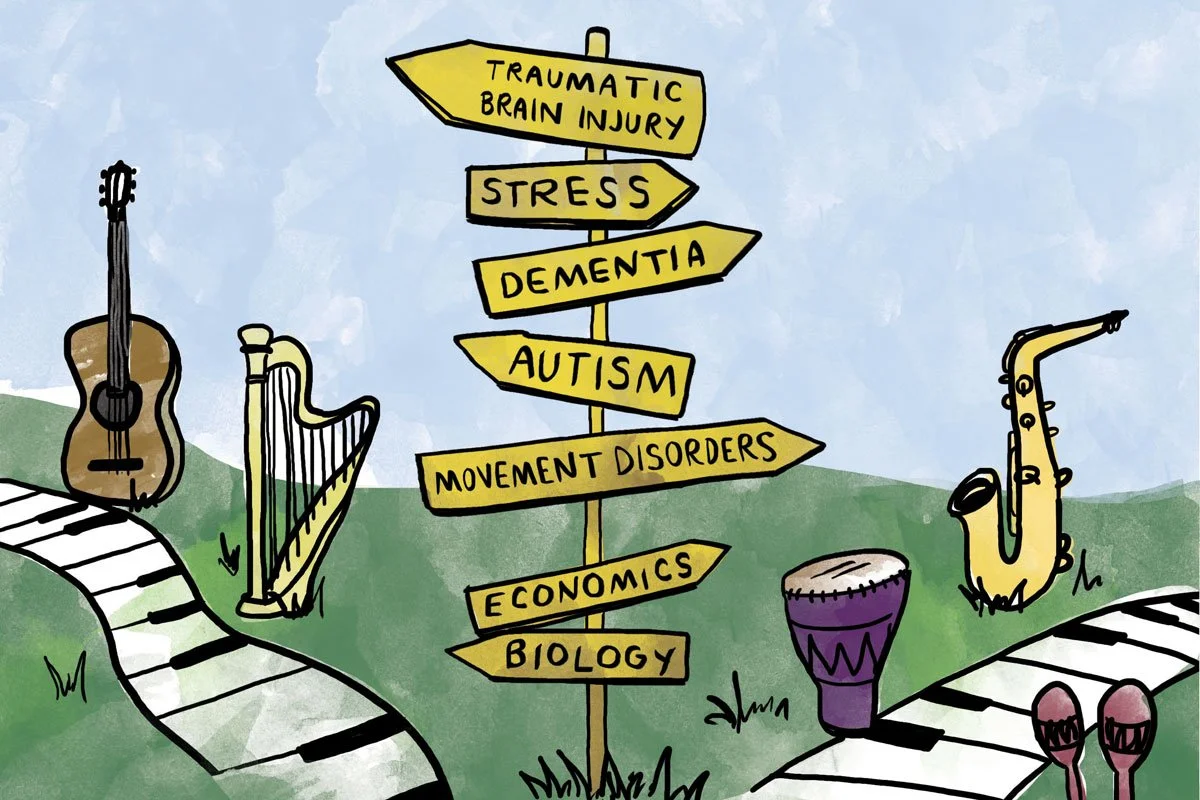
At the 2026 Pacific Coast Conference, Dr. Julene Johnson presented an overview of the current knowledge on music representation in the brain, along with an introduction to music’s use in medicine. Music is one of few constant features across human cultures, with emerging research beginning to uncover the many ways that music can improve health and well-being across populations.
Traditional medicine systems in Greece (5th-4th century BCE) and China (1st century CE) incorporated music, with the belief that different instruments, tones, or scales could influence physical and mental health. As modern brain science developed, early models of language processing included music as an undefined offshoot of language systems. In recent decades, brain scientists have identified a distributed pattern of musical processing beyond the auditory cortex and temporal lobe. These distributed representations of music in the brain drive interactions between auditory and motor, limbic, and autonomic networks. Often, musical characteristics, such as timbre or rhythm, are processed in brain regions typically thought of as emotional- or movement-related areas.
Because music is processed across these brain regions, deliberately chosen music may influence how they function. Dr. Johnson presented research suggesting that this influence is feasible and discussed the use of various types of engagement with music for those with specific needs. She distinguished between music therapy, delivered by credentialed music therapists, and music medicine, delivered by other health care professionals. These music-based interventions (MBIs) encompass producing music by singing or playing instruments, listening to music, improvising music, and pairing music with movement. Dr. Johnson highlighted MBIs as patient-centered interventions that are enjoyable for patients and can be administered in any setting. Research interest has increased in recent years.
The link between music and motor circuits shows up dramatically in the clinic: The rhythmic stimulation of music can help patients with Parkinson disease and stroke survivors move more fluidly. This effect is due to the rhythmic stimulation that music provides. Music can also help patients with dementia unlock memories that were previously inaccessible. Dr. Johnson explained that this process occurs because everyone has a “playlist of life,” or music associated with specific life epochs or occasions. Dementia care uses the music that was loved in adolescence and early adulthood to stimulate positive emotions and memories. This result is possible because the parts of the brain that process familiar music generally degenerate much later in dementia than other parts of the brain. Dr. Johnson found that participation in community choirs can increase “interest in life” and reduce loneliness in adults older than 60 years. An ongoing study is testing whether training in musical improvisation, a challenging cognitive task requiring simultaneous demands on working memory, pattern recognition, and motor control, can improve cognition in adults with early cognitive decline. Parallel work has shown that mid-life musical training may delay dementia or other cognitive decline.
Music-based interventions are also being studied by others as options for supportive care across a wide range of indications, such as psychiatric conditions, including depression, anxiety, and schizophrenia, cardiovascular and respiratory conditions, cancer, and palliative care. The strongest evidence supporting MBI efficacy is in psychological conditions and cancer-related depression, anxiety, and pain. Emerging evidence suggests that music can improve overall quality of life in individuals with cancer, autism, dementia, schizophrenia, and substance use disorders. National Institutes of Health (NIH) cooperatives across several institutions are funding research aimed at identifying ways that MBIs can improve care and outcomes for people with dementia and can reduce pain. Although still in the early stages, this research suggests that MBIs are low-risk, low-cost interventions that may improve health broadly, with minimal or no adverse effects.
Dr. Johnson led the Sound Health Network, with support from the NIH and the Kennedy Center, which created a series of video resources explaining the benefits of music to health to the general public. The series also includes video interviews with music therapists, musicians, and researchers. Dr. Johnson encouraged AMWA members to explore these resources and to use our communication skills to strengthen public engagement with and awareness of the potential of MBIs to improve health across the lifespan and health conditions.
About the author: Alexandra Yasin is a freelance medical writer specializing in strategy-to-submission publications and grant proposals. She earned her PhD in neurobiology from the University of California, Irvine; her initial interest in neuroscience was sparked by research like Dr. Johnson’s. Currently, she helps small businesses in neurobiology, oncology, and medical devices fund their studies and communicate their findings.