Overcoming the Challenges of Expedited Submission Times With Planning, Top-Down Messaging, and Parallel Writing

The planning of regulatory submissions was presented by Brenda Taylor, MS, Director of Global Submissions at Veristat, at the Pacific Coast Conference (PCC) of 2026.
Regulatory applications are complex. They involve hundreds of files and increasingly shortened timelines from receipt of last study data to submission. There are methods that enable simultaneous writing of reports, summaries, and overviews for expedited time to submission. These methods require extensive planning, top-down messaging, and parallel writing, with management support being critical for success.
PCC session presenter Brenda Taylor, MS, began with an overview of submission timeline trends, with time from database lock to submission historically being around 26 weeks. However, the current trend, post-COVID-19, is for 10-week timelines from receipt of topline results or drafted tables, figures, and listings to submission. These expedited timelines require early, up-front planning to
map the critical path and any rate-limiting steps
create a content plan with all functions aligned
account for other influences
E.g., simultaneous global submissions, health authority meetings, and generating materials for conferences
An expedited submission has certain requirements. First, the delivery date must be known, and everything that is not dependent on final data must have already been drafted, reviewed, and agreed on. Drafting text in advance may save time if data interpretation matches the expected messaging. Furthermore, use of document “shells” (i.e., outlines) ensures that final data can be dropped in to the files at the last minute. Second, there should be an emphasis on correct statistical outputs, with potential use of artificial intelligence for automation, especially for generating tables, figures, and listings. Third, to achieve the expedited submission goal, authoring of the files occurs in parallel. Good team communication is key so that authors do not change sections that have already been signed off. Lastly, plans must also account for data access restrictions that may occur prior to press releases.
The common technical document (CTD) triangle is a visual representation of the modular structure of pharmaceutical regulatory submissions. Taylor used the CTD image to emphasize that data flow from the bottom to the top of the triangle (i.e., from data and study reports to overviews and summaries, and then to administrative and prescribing information). In contrast, messages and label claims flow from the top to the bottom of the triangle (Figure 1).
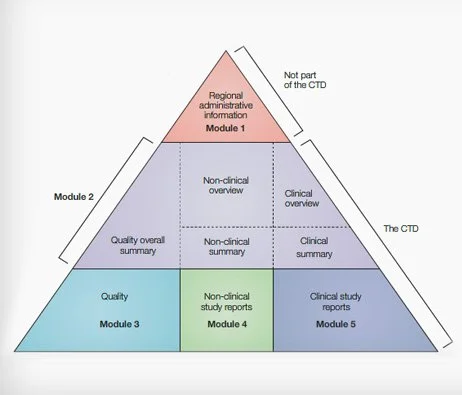
Figure 1. The eCTD contains an electronic table of contents, also referred to as a backbone, that contains all the metadata for an application. This backbone is broken down into five modules. Documents are placed appropriately into modules, which are graphically presented as the CTD Triangle.
(Source: https://www.accessdata.fda.gov/scripts/cder/training/ectd/backgr/backgr/fd_02_01_0030.htm)
As a recommendation, a top-down approach for writing regulatory applications uses prescribing information and clinical overviews to draft documents, with data filling in the gaps later. The goal is to begin the top-down approach approximately 9 months to several years before phase 3 results are available.
Despite some disadvantages, such as teams being unfamiliar with the messaging or writing based on unknown results that may need to be reworked, there are noteworthy advantages to this approach. As an example, Taylor has found that when writing begins earlier, the process provides a roadmap for lower-level documents, allows faster and less hierarchical writing, and fills gaps.
Implementation of this approach requires
a target product profile
prescribing information
a storyboard
key messages
senior management buy-in (to support communication)
a writing lead (to ensure consistency of messaging)
Despite being the fastest approach to submission, parallel writing requires constant refining rather than iterative development and requires many hours of work. Taylor compared the pros and cons of parallel writing with those of sequential and staggered writing. The staggered approach (i.e., with most of the writing moved earlier in the process, before final data approval) balances speed to submission with more efficient internal review processes.
Once the application is ready, expedited timeframes necessitate a limited 24-hour review and approval turnaround time before submission. To this end, the number of reviewers and approvers should be defined early on. The reviewers and approvers should be trained on the expedited process (i.e., allowed limited interventions only), with senior management helping to enforce the deadline. Taylor noted that artificial intelligence has limitations in this review and approval process; lockdowns (e.g., in-person, long, isolated team meetings) may be useful to ensure documents are finalized on time. The expedited process, according to Taylor, is akin to “herding cats.”
Common pitfalls with this process include
expecting that agreements made before final data should be kept after the data are available
not identifying all submission content or missing an item
leaving content that is not data-dependent undrafted
allowing extensive revision after final data drop-in
not having full top-down management support and engagement
To conclude, Taylor emphasized that expedited submission times are achievable with planning, top-down messaging, and parallel writing. A productive and engaging discussion period followed. Thank you to Brenda Taylor for her effort in putting together this presentation for the conference attendees.
About the author: Michelle McRae, PhD, ELS, is a part-time senior medical editor at Merck and a freelance scientific and medical editor, fact-checker, and AMA style specialist. Her clients include medical communications companies, medical societies, journals, and academics. Michelle is a certified Editor in the Life Sciences and is the Volunteer Coordinator for the American Medical Writers Association Northern California Chapter.